

What is TED?
Thyroid Eye Disease (TED) is a serious, lifelong, debilitating and potentially vision-threatening autoimmune disease. It can significantly impact emotional well-being, daily activities and quality of life.1,2
TED belongs to a group of conditions known as autoimmune diseases.3 With autoimmune diseases, the body’s own immune system mistakenly attacks healthy cells.4 With TED, the body’s immune system attacks healthy muscle and fat tissue behind the eyes.3 TED is also progressive, which means it can get worse over time.2,4
If you have TED, your eyes may become red, swollen and bulging. As well as changes to their appearance, your eyes may feel gritty, dry or watery and you may experience double vision. Your eyes may become painful.1,6,7
You are at a higher risk of developing TED if:
 You have an autoimmune thyroid condition8,9
  You smoke10
  You are a woman11
  You are aged over 4012
 Commonly Used Terms for TED
TED is a unique condition but is often mistakenly considered part of another disease called Graves’ disease.13 It’s important to know that Graves’ and TED are different diseases and require different management and care.8,9 Although they are separate conditions, TED may be called by names containing the word Graves’ or thyroid, like:

- Graves’ eye disease14
- Graves’ ophthalmopathy (GO)3
- Graves’ orbitopathy (GO)3
- Thyroid-associated orbitopathy (TAO)15
- Thyroid ophthalmopathy16
If you hear any of these terms, know that they mean Thyroid Eye Disease (TED).
Diagnosing TED
TED is progressive and catching it early is important, so it’s best to seek care from a doctor experienced in managing the condition.10
TED is usually managed by an eye doctor, such as an ophthalmologist or oculoplastic surgeon.3 Some ophthalmologists and oculoplastic surgeons have additional training and specialise in treating TED.17 If possible, it’s best that an endocrinologist (doctor who treats thyroid conditions) and an ophthalmologist work closely together to manage TED.18 You may also be looked after by doctors (and other healthcare professionals) with additional training on your specific conditions. These doctors may include endocrinologists, oculoplastic surgeons and neuro ophthalmologists, orthoptists, among others. You may also be looked after by doctors with additional training on your specific conditions.19 These doctors may include oculoplastic surgeons17and neuro-ophthalmologists,20 among others.


Three Facts About TED
 TED is 5 times more common in women than men11
  Many people with TED are initially misdiagnosed as having conditions such as allergy, conjunctivitis or dry eye disease20,21
  TED can flare, meaning that signs and symptoms ma return or worsen. Approximately 15% TED patients experience flares regardless of how the disease has been treated22
 How TED Develops
Thyroid Eye Disease (TED) can get worse over time if left untreated, which is why it’s important to look out for important signs and symptoms including:1,3,22
 Dry, gritty eyes
  Watery, teary eyes
  Eye pain and eye pressure
  Blurry vision
  Bulging eyes
  Swollen, puffy eyelids
  Colour vision loss
  Sensitivity to light
  Double vision
  Eyelids not closing properly
  Eyes that point in different directions
  Vision loss
 If you are experiencing new or worsening symptoms, change in your vision or are concerned, you should seek immediate medical advice from your doctor or care team
Stages of Disease
TED can be divided into two main stages, known as the active phase and the chronic phase.24,25 It is important for you and your doctor to know which stage you are at, so that you can receive the treatment that is right for you.
Active phase25
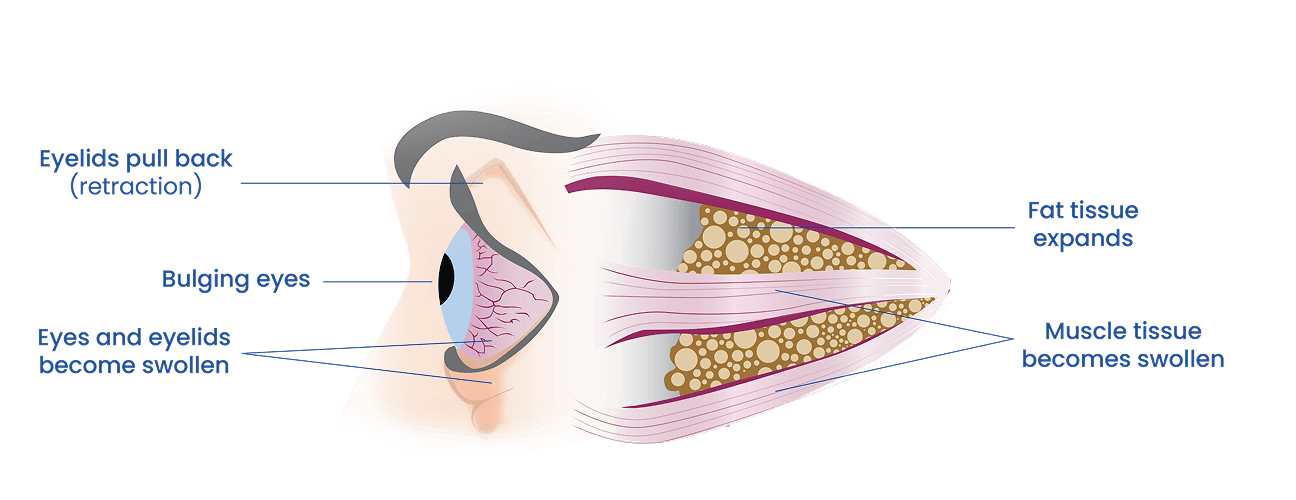
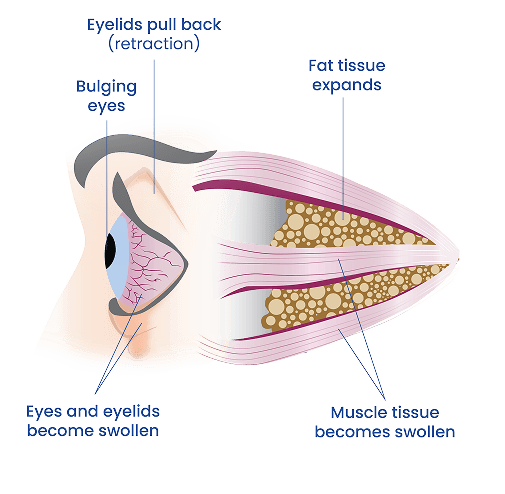
- During this time, the signs and symptoms of TED may appear suddenly and get worse over time.25
- You may notice changes in your appearance and vision, including: redness, swelling, dry, gritty eyes, eye bulging, double vision, misaligned eyes or eyes that don’t work together, sensitivity to light, eye pain and pressure.25
- As with many conditions, don’t put off seeking medical help. The sooner you speak to your doctor, the earlier you may be able to receive appropriate treatment.
Chronic phase25
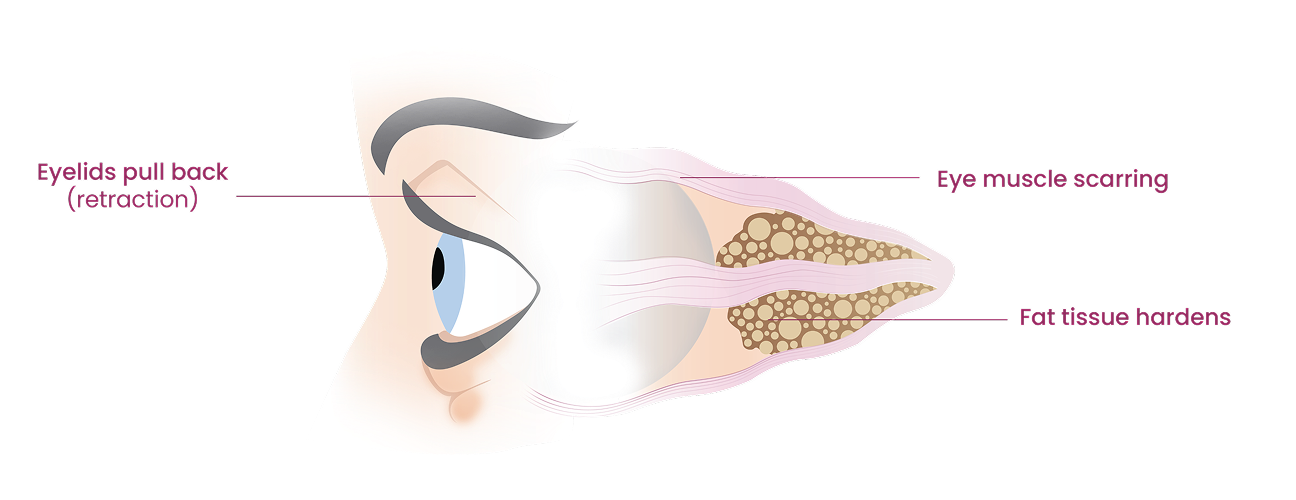
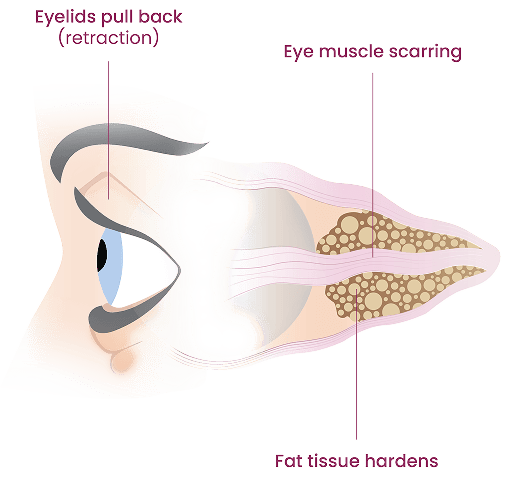
- You may be entering the chronic phase if the inflammation and swelling have slowed or stopped, redness has decreased or gone away, and eye bulging hasn’t got any worse.25
- Scar tissue from the acute phase may leave you with pain, eye pressure, double vision and misaligned eyes.1,6,25
- The longer that TED goes untreated, the more likely it is for serious damage to happen to your eyes.22
- Since TED is an autoimmune condition, over time you may experience "flares", which is when your symptoms suddenly come back or get worse despite no changes in quite some time.
- A few potential causes for flares are stress, eye surgeries, pregnancy, medications, changes in thyroid levels and more.23
- If you think you are experiencing a flare in your TED symptoms, it’s important to seek care quickly.
-
References
- Wang Y, Patel A, Douglas RS. Thyroid Eye Disease: how a novel therapy may change the treatment paradigm. Ther Clin Risk Manag.2019;15:1305-1318
- Smith TJ, Hegedüs L, Lesser I, et al. How patients experience thyroid eye disease. Front Endocrinol. 2023 Nov 9;14:1283374
- British Thyroid Foundation. Your guide to thyroid eye disease. https://www.btf-thyroid.org/thyroid-eye-disease-leaflet. Accessed: April 1, 2025.
- NIEHS. Autoimmune Disease. https://www.niehs.nih.gov/health/topics/conditions/autoimmune. Accessed: February 21, 2025
- Global Autoimmune Institute. What is autoimmune disease? https://www.autoimmuneinstitute.org/understanding-autoimmune-disease/. Accessed: April 1, 2025.
- Bothun ED, Scheurer RA, Harrison AR, et al. Update on Thyroid Eye Disease and management. Clin Ophthalmol. 2009;3:543-551
- Dolman PJ. Grading severity and activity in Thyroid Eye Disease. Ophthalmic Reconstr Surg. 2018;34(4S suppl 1):S34-S40
- Ueland, HO, Ueland GÅ, Løvås K, et al. Novel inflammatory biomarkers in thyroid eye disease. Infl biomarkers in thyroid eye disease. 2022; 187(2):293-300
- Smith TJ, Hegedüs L. Graves’ disease. N Engl J Med. 2016;375(16):1552-1665
- Szelog J, Swanson H, Sniegowski MC, et al. Thyroid Eye Disease. Mo Med. 2022 Jul-Aug;119(4):343-350
- Lazarus J. Epidemiology of Graves' orbitopathy (GO) and relationship with thyroid disease. Best Pract Res Clin Endocrinol Metab. 2012. Jun;26(3):273-9
- Bartley GB, The epidemiologic characteristics and clinical course of ophthalmopathy associated with autoimmune thyroid disease in Olmsted County, Minnesota. Trans Am Ophthalmol Soc. 1994; 92: 477–588
- Cleaveland Clinic. Thyroid Eye Disease. https://my.clevelandclinic.org/health/diseases/17558-thyroid-eye-disease Accessed: April 1, 2025.
- NIH. Graves’ Eye Disease. https://www.nei.nih.gov/learn-about-eye-health/eye-conditions-and-diseases/graves-eye-disease Accessed: April 1, 2025.
- Maheshwari R, Weis E. Thyroid associated orbitopathy. Indian J Ophthalmol. 2012 Mar-Apr;60(2):87-93
- Parmar H, Ibrahim M. Extrathyroidal Manifestations of Thyroid Disease: Thyroid Ophthalmopathy. NeuroIm Clinics of North America. 2008;18(3):527-536
- Top Doctors. Oculoplastics. https://www.topdoctors.co.uk/medical-dictionary/oculoplastics Accesssed: April 1, 2025.
- Burch HB, Perros P, Bednarczuk T, et al. Management of thyroid eye disease: a Consensus Statement by the American Thyroid Association and the European Thyroid Association. Eur Thyroid J. 2022 Dec 8;11(6):e220189
- British Thyroid Foundation. Thyroid Eye Disease (TED). https://www.btf-thyroid.org/listing/category/thyroid-eye-disease-ted Accessed: April 1, 2025.
- Moorfields Private Eye Hospital. https://www.moorfields.nhs.uk/private/eye-conditions-and-treatments/neuro-ophthalmic-conditions Accessed: April 1, 2025.
- PennMedicine. Thyroid Eye Disease (Graves' Disease). https://www.pennmedicine.org/for-patients-and-visitors/find-a-program-or-service/ophthalmology/thyroid-eye-disease-graves-disease#:~:text=TED%20is%20often%20difficult%20to,wrong%20season%20for%20hay%2Dfever. Accessed: April 1, 2025.
- Barrio-Barrio J, Sabater AL, Bonet-Farriol E, et al. Graves’ Ophthalmopathy: VISA versus EUGOGO Classification, Assessment and Management. Journal of Ophthalmology. 2015; 24912.
- Patel P, Khandji J, Kazim M. Recurrent Thyroid Eye Disease. Opthalmic Plastic and Reconstructive Surgery. 2015; 31:445-8
- Shah SS, Patel BC. Thyroid Eye Disease. [Updated 2023 May 22]. In: StatPearls [online]. Jan 2024. https://www.ncbi.nlm.nih.gov/books/NBK582134 Accessed: April 1, 2025.
- NORD. Thyroid Eye Disease. https://rarediseases.org/rare-diseases/thyroid-eye-disease/ Accessed: April 1, 2025.
You Are Leaving This Website
You are leaving this patient disease awareness website and will be taken to an Amgen corporate website intended for a range of audiences.
For medical advice, contact your doctor. For medical information or to report side effects, please use the next page.
GBR-532-26-80004 February 2026.